Drosera Obscura
Drosera Obscura is an innovative project that merges cutting-edge extended reality (XR) technology with full sensory engagement to create a truly immersive experience. The installation combines virtual reality, animatronics, sound design, olfactory stimuli, and physical interaction, blurring the boundaries between the digital and physical worlds. Through this multi-sensory approach, the project seeks to redefine immersion, allowing audiences to experience a narrative not just through visuals, but also through sound, touch, and scent.
This collaborative effort brings together experts from diverse fields such as music, vocal performance, art, industrial design, engineering, and computer science. The interdisciplinary team is dedicated to pushing technological boundaries while exploring deeper, more engaging experiences. Central to the development of Drosera Obscura are two major institutions: the Institute for Creativity, Arts, and Technology (ICAT) at Virginia Tech and the Centre for Interdisciplinary Research in Music Media and Technology (CIRMMT) at McGill University. These institutions will support the installation’s creation through their advanced facilities—ICAT Cube and McGill’s Multimedia Room—providing ideal spaces for developing and testing this multi-sensory XR performance.
In addition to XR technology, the project draws on the expertise of researchers and students working on pioneering aspects of interactive sound and music synthesis. The team will explore new ways to blend computational acoustics, immersive systems, and adaptive interfaces, expanding how technology interacts with human senses in a performance setting. The collaboration between ICAT and CIRMMT will strengthen institutional connections, fostering knowledge exchange and advancing technologies with significant potential for the music, sound, and interactive media industries. Over the next year, the project will undergo multiple iterations, leading to live XR performances at both locations. These performances will showcase the integration of sound, visuals, and physical interaction, testing the technology while demonstrating the potential of immersive art to engage participants in entirely new ways. Drosera Obscura aims to be a groundbreaking project in the field of multi-sensory immersive experiences. Drosera Obscura aligns with ICAT’s mission to explore the intersection of technology and human experience, making it a groundbreaking project in multi-sensory immersive experiences. Through collaboration across disciplines, it pushes creative and technological boundaries to redefine immersive storytelling and engagement.
Mid-term Report
The Drosera Obscura XR Project made significant advancement during Fall 2025, expanding both its creative and technical scope while strengthening its collaborative network in preparation for a large scale multi-site performance planned for Fall 2026. Central to this semester’s achievements were the November 23 and November 25 workshopping sessions and performances in the ICAT Cube, which allowed the full team to test the XR, animatronic, audio, haptic, and scent systems in a fully immersive environment. These sessions were supported by the expertise of David Franusich, Tanner Upthegrove, and Gustavo Araoz, who ensured that the spatial configuration, sound system, projection setup, and installation hardware were precisely tuned to meet the needs of the developing performance. Their work created an ideal environment for faculty collaborator Ariana Wyatt and six vocalists to refine the integration of live performance with the animatronic and XR elements. These rehearsals advanced our technical workflow and provided essential preparation for the upcoming collaboration with McGill University’s CIRMMT, where Drosera Obscura will be performed across three countries simultaneously.
The semester was further strengthened by the presence of Tohm Judson, who traveled from Seattle to participate in the project as a visiting artist. During his stay he lived in the CID LLC, where he presented his research to students, offering insight into his work in sound, music, and narrative design as they intersect with immersive and interactive performance. Throughout the week he played a key role in setting up sound and interactive audio systems, refining the structure of the dress rehearsal, and contributing essential ideas that shaped the conceptual direction of the next iteration. His presence was crucial in helping define both technical adjustments and narrative strategies that will be implemented in the McGill performance.
This work was complemented by the participation of Matthew Swarts (also visiting artisit at CID LLC), who traveled from Georgia Tech to join the project for two days. During this visit he assisted in the final performance preparation inside the ICAT Cube and observed how the layered systems behaved in a live structured environment. Following the performance he led a feedback session with students and faculty, identifying important refinements needed before next year’s development cycle. His insights were especially influential in determining the next phase of sensor tuning, haptic refinement, and wireless system reliability.
The core team for Drosera Obscura includes faculty, students, and collaborators from multiple institutions. The Virginia Tech faculty collaborators are Thomas Tucker, Dongsoo Choi, Ariana Wyatt, and Brook Kennedy. The McGill University contributors are Dr. Marcelo Wanderley and Dr. Suresh Krishna, whose expertise in spatial audio and perceptual neuroscience shape the performance environment. External collaborators include Yamin Xu from Bowling Green State University, Matthew Swarts from Georgia Tech, and Tohm Judson from the University of Washington. The student team consists of Jason Hodge, Matt Finn, and Sydney Dechow. The vocalists and puppeteers are Che Botsford, Kaeli Berry, Ellie Dunn, Anishka Kolli, Evangeline Menendez, and Mary Stanford Austin. This diverse group collectively supports the creative, technical, and performative development of the project.
International expansion of Drosera Obscura was further advanced through my Fulbright Specialist residency in Galway, Ireland, which took place from October 16 through November 16, 2025. The residency established new relationships with faculty, creative technologists, and industry professionals at the University of Galway, the Burren College of Art, and local film and gaming communities. I left one animatronic robot in Galway, where a paid student collaborator named Alec is now supporting prototyping and testing for the European development phase of the upcoming three country performance. These Fulbright initiated partnerships form an essential foundation for the multi-site XR performance to be staged in Fall twenty twenty six between Galway, Blacksburg, and Seattle.
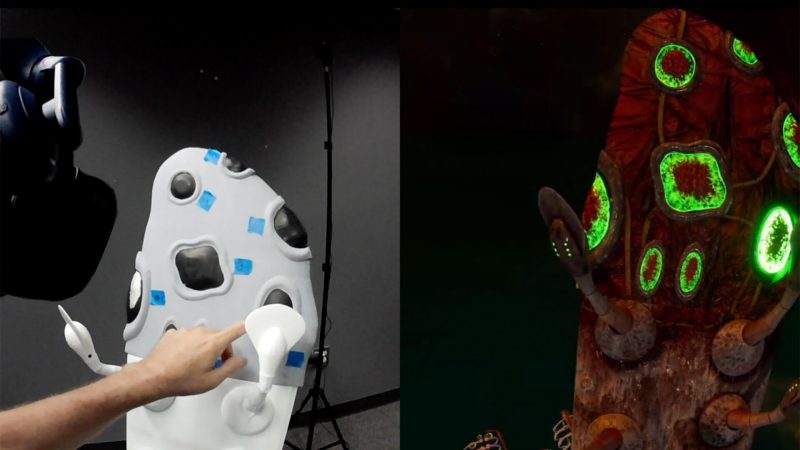
Technically, the project advanced in several major areas. The team moved beyond static VR to develop a fully interactive multisensory system where real time animatronic motion was driven by Maya Python scripting connected to Pololu boards, while VIVE tracker puppeteering enabled performers' gestures inside VR to trigger corresponding physical movements. These interactions engaged a network of sound design, Houdini based particle effects, scent release from compact embedded scent cannons, and haptic sensations delivered through wearable vests designed to simulate environmental conditions such as rain or wind. The nighttime posthuman cranberry bog environment, conceptualized through narrative development work initiated by Tohm Judson, informed the interplay of sound, light, scent, movement, and embodied participation.
Student contributions were essential to this progress. Sydney Dechow refined the form and ergonomic design of the animatronic bodies. Matt Finn redesigned the base platform for mobility, power stability, and transport, while also integrating proximity sensors that activate through changes in capacitance. Jason Hodge streamlined the communication pipeline between Maya, Arduino, and Unreal Engine by rewriting firmware and removing unnecessary dependencies. Faculty collaborators played equally crucial roles. Brook Kennedy contributed early industrial design strategies that shaped the material properties and form language of the robots. Matthew Swarts introduced systems that integrated sensor arrays, audio feedback, haptic interactions, and wireless data flow. Dongsoo Choi executed extensive hardware assembly work across multiple high density circuit boards.
The project benefits from wide public exposure. Previous exhibitions at SEAMUS in New York City, Ars Electronica in Austria, and SIGGRAPH in Colorado have reached thousands of attendees and brought valuable critical insight. Support from the ICAT Mini SEAD Grant and the McGill and ICAT collaborative funding program continues to move the project forward. In addition to these awards, I secured an extra one thousand dollars in CHCI funding through a board vote and received two thousand dollars in supplemental support from ICAT to help bring the project across the finish line for this semester’s work and to prepare for next year's international expansion. These combined resources are allowing us to begin constructing five wireless animatronic robots capable of interacting with each other and with participants through Unreal Engine.